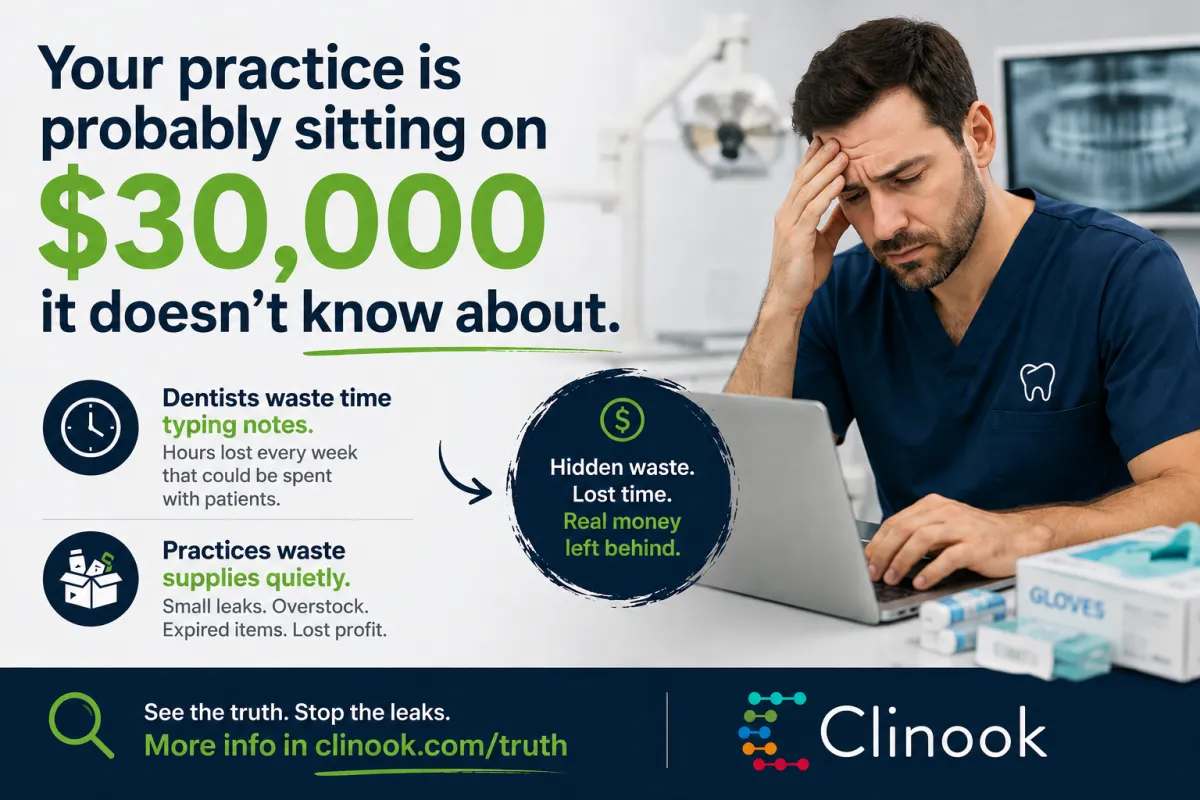
Your practice is probably sitting on $30,000 it doesn't know about
Let’s play a quick game.
If someone told you there was $30,000 sitting inside your practice — not from new patients, not from a new service, not from a marketing campaign — just from running things more clearly, would you want to know where?
Most dentists would say yes. And then go back to looking at their schedule.
The invisible leak in your supply closet
Here’s a number worth knowing: the average dental practice spends 7.2% of collections on supplies. The industry benchmark is 6%. On an $800K practice, that 1.2% gap is roughly $10,000 a year.
Not stolen. Not mismanaged on purpose. Just quietly lost — in expired composites nobody noticed, in over-ordered gloves that sat in a drawer for 18 months, in supplies that were tracked on a spreadsheet that nobody updated after the last ordering rotation.
This isn’t a purchasing problem. It’s a visibility problem. When you can’t see what you have, you buy what you think you need. When you can’t see expiration dates, product quietly becomes trash. When you can’t see the cost of each material used per procedure, you can’t know if that procedure is actually making you money.
The other $24,000 (hiding in plain sight)
Now let’s talk about doctor time.
At $500 an hour, one hour per week spent on clinical documentation instead of patient care is $26,000 a year in production that never happens. That’s not an estimate — that’s just math.
The irony is that most practices have accepted this as the cost of doing business. Notes take time. That’s just how it is. Except it doesn’t have to be. AI-powered clinical note dictation has gotten to the point where a dentist can dictate and move on — no typing, no backtracking, no staying late to finish charting.
That time doesn’t disappear. It goes back to the doctor. What they do with it — more patients, earlier finishes, less burnout — is up to them. But the option now exists.
So why don’t more practices fix this?
Partly because these losses are slow. They don’t show up as a line item on a P&L. They just show up as margins that are slightly worse than they should be, month after month, year after year. Nobody’s hair is on fire. So nobody looks.
And partly because the tools to actually see this clearly haven’t been built for dental offices specifically — until recently.
What “control” actually looks like
The practices that are recovering this money aren’t doing anything exotic. They’re doing three things:
1. Tracking inventory in real time — knowing exactly what’s on hand, what it cost, and when it expires, without manual counting.
2. Knowing their cost per procedure — so when a crown goes out, they know what it actually cost to deliver, not just what they charged for it.
3. Using AI for documentation — so clinical notes happen at the speed of conversation, not at the speed of typing.
None of this requires a consultant, a new hire, or a six-month implementation. It requires visibility — the kind that most practice management systems don’t offer because they were built to handle scheduling and billing, not operational economics.
The question isn’t whether the money is there. For most practices, it is. The question is whether you’re set up to see it.
Figures based on industry averages. Individual results vary by practice size and workflow.